How the Personal Agent Protocol works
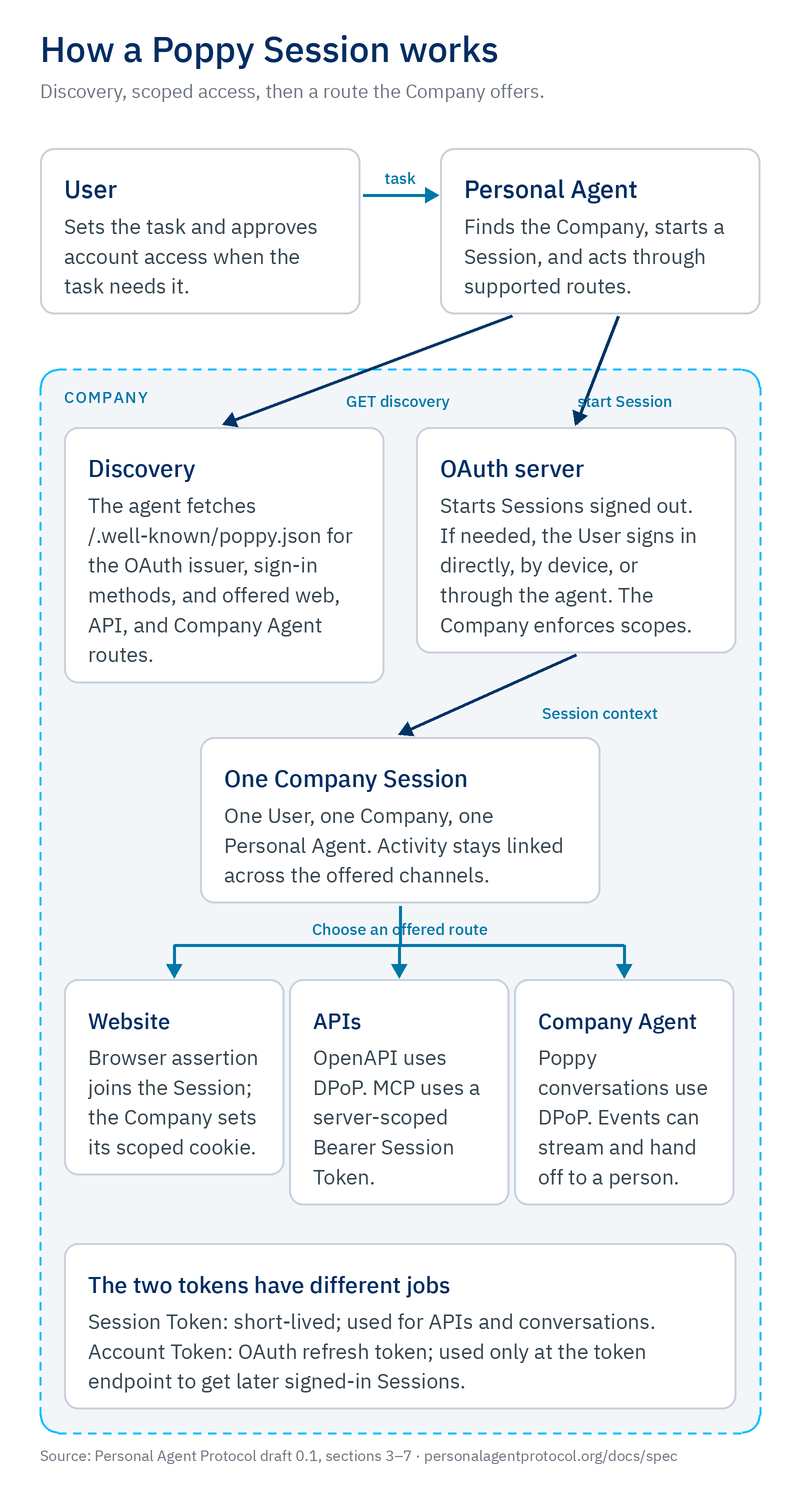
A Poppy visit starts on the company's website. The agent can stay a guest or the customer signs in through OAuth and picks read-only or write. Then the company decides how the agent finishes the job: its website, its APIs or its own agent.
One visit
Three parties share the visit: the customer, their personal agent, and the company. The session is built on OAuth.
1. Discover
The agent fetches /.well-known/poppy.json. The document lists the company's sign-in methods and whichever web, API, and company-agent routes it offers.
2. Start a session
The agent begins a session for the user. It can start as a guest. That can be enough to check product availability or ask about a returns policy.
When the task needs the customer's account, the customer signs in on the company's page or uses credentials already set up with the personal agent.
3. Choose access
The customer stays in control and decides whether the agent has:
- Read-only access
- Write access
The draft defines broad poppy:read and poppy:write scopes. Companies choose which operations each scope permits and may define narrower scopes of their own.
4. Keep one visit
The OAuth session carries across channels. A question asked before sign-in and an order change made afterward are part of the same visit.
Three routes
After the session exists, the agent uses whichever route the company believes will offer the best customer experience. The company decides what it makes available.
Website
The agent navigates the company's regular web pages.
APIs
The agent connects through interfaces built on standards such as MCP andOpenAPI. Those are the two standards the announcement names.
Company agent
The agent works through the company's own agent when the task needs conversation. The announcement's example is a warranty claim.
What each party gets
| Party | Decides | Gets |
|---|---|---|
| Customer | What access the agent receives | A faster way to finish the task |
| Company | Parameters and which routes exist | Visibility into an agent acting for a customer |
| Agent builder | How the agent uses the offered routes | One consistent way to connect |
Identity has a boundary
Draft 0.1 identifies the personal agent with its HTTPS client_id. The user ID is stable for that agent at one company, opaque, and different at every company. A company can require agent registration, keep allowlists or blocklists, and revoke an agent ID. The draft does not define a universal user identity or a trust claim from an agent operator that follows a customer across companies.
That distinction responds to a question raised by Colin at Clerk: could services rely on an agent operator to identify the signed-in user? Poppy v0.1 puts account identity through the company's own sign-in flow instead. The tradeoff is worth watching: it limits cross-company identity sharing, while leaving operator-level trust and recognition outside this draft.Read Colin's post →
Explore Poppy implementations
Community projects now include SDKs, clients, pre-draft samples and partner demos. Each listing describes the draft version and flows it covers, along with known limitations.Browse Poppy implementations →
Planned, not in the first cut
Sierra and Meta described these as possible next steps, alongside the v0.1 spec, design workshops, and a reference implementation:
- More detailed permissions — customers and companies set limits on specific actions
- Push notifications — a company tells the agent when a flight is delayed or an order ships
- Payment extensions — the agent completes a purchase without sharing credit card information
Next
Glossary →
Terms used on this site, kept to what the announcement actually says.
Partners →
Who's named, by whom, and what they said.
Sources
- Sharing a draft of Personal Agent Protocol · Sierra (Bret Taylor, Clay Bavor), Oct 9, 2026 · primary source
- Personal Agent Protocol overview (Draft 0.1) · Personal Agent Protocol, Oct 9, 2026 · primary source
- Personal Agent Protocol specification (Draft 0.1) · Personal Agent Protocol, Oct 9, 2026 · primary source
- Community feedback on agent and user identity in Poppy · Colin (Clerk) on X, Oct 10, 2026
poppy.md is independent and not affiliated with Sierra, Meta or any Poppy partner. Facts here come from the sources listed on each page.